
;)

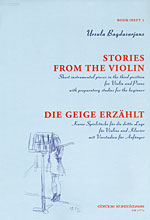
Short instrumental pieces in the third position for Violin and Piano with preparatory studies for the beginner
Book 1 (GM1777a) is available at your music shop or via Internet from following publishers:
| – | Edition Kunzelmann (Switzerland/Worldwide) |  |
| – | Alle-noten (Germany/EU) | |
| – | Sheetmusicplus (USA) | |
| BOOK 2 (GM1777b) – "THE
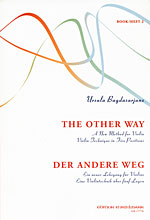
OTHER WAY" A New Method for Violin. Violin Technique in Five Positions Book 2 (GM1777b) is available at your music shop or via Internet from following publishers:
|
 |
||||||||||
 |
May 2005
New publication at Edition Kunzelmann
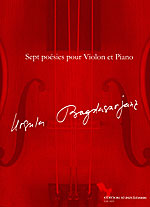
BOOK 3 – "SEPT POÉSIES POUR VIOLON ET PIANO"
Ursula Bagdasarjanz
Edition Kunzelmann, GM 1833
Book 3 is available at your music shop or via Internet from following publishers:
| – | Edition Kunzelmann (Switzerland/Worldwide) | |
| – | Alle-noten (Germany/EU) | |
| – | Sheetmusicplus (USA) | |
Gipsy-Romance
and Dracula
On July 12 and 13 2004, two compositions of Ursula Bagdasarjanz have been successfully
premiered in the banquet hall of the town house in Sighisoara, Vlad Dracula’s
place of birth, and in the big hall of the culture palace in Târgu Mures,
Transylvania, Romania.
FOR FUTURE VIOLINISTS!
"Many roads lead to Rome, but there is one that is unavoidable, necessary and vital: targeted training. This is true whether in music or sports. For musicians this means that the better your technique is, the more you can express the full range of tonalities in a joyous, warm and personal way."
Ursula Bagdasarjanz, violinist
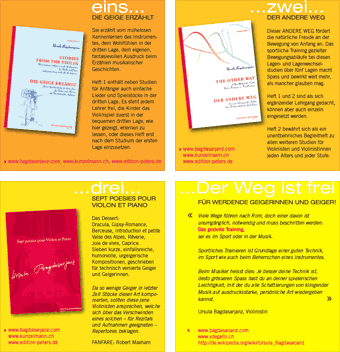
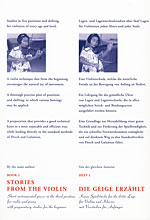
Book 1 and Book 2 are intertwined parts of a method book for violin. While Book 1 contains, in addition to studies for the beginner, songs and instrumental pieces that encourage students in making music, Book 2, for violinists of every age and level, is a violin technique covering five positions whose main emphasis is on learning the positions and shifting in a proper hand/arm position as early as possible. Most exercises begin with the 4th finger. Together with an introduction to scales, they provide a good technical basis, leading directly to the standard methods of Flesch and Galamian.
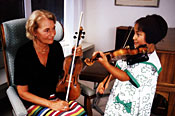
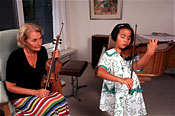
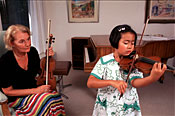
Ursula Bagdasarjanz giving violin lessons (Schweizer Illustrierte vom 05.09.1997)
Text and exercises should simplify the teacher's conveying of the material. Reading the text that contributes significantly to thorough, overall understanding is recommended.
I have taught violin students for many years, from beginners to aspiring professionals. In my youth, when I performed as a soloist on numerous stages, I was not yet interested in the beginner. However, experience has taught me that it is precisely the beginning of violin studies that is the key factor in the development of a violinist. Much can be built upon but also lost in the way one learns to play the instrument. This insight led me to search for my own principles of teaching and practise methods, which I present here. The fruits of this long teaching experience have now been translated into the studies composing the two books. My aim is to prevent violinists from taking a roundabout path, in order that they may acquire the technical means for making music as early as possible.
What is important to me are not just the individual exercises but that the path which is followed is like a recurring central theme throughout the work. With a little imagination, every teacher and child can create other exercises. However, what is new in this method are the unusual principles of teaching and practise methods. In the preparatory studies, playing in the 3rd position by plucking the strings (pizzicato) is prepared along with open string bowing exercises. Then, as soon as the notes can be bowed, the exercises in Book 2 first move from the 3rd position to the 1st position, then from the 4th position to the 2nd and 5th positions. From the very beginning, the left arm and the left hand develop in the proper arm/hand position more rapidly than usual. At an early stage, a good finger technique that builds the strength and agility of the fingers is developed. Through the varied exercises for differentiating tone-semitone steps, a pure intonation is fostered: an in-depth knowledge of the positions and shifting is brought about along with a natural confidence when playing. Depending on the level of the student's development, corresponding études and music pieces may be studied in addition to these exercises.
I hope to contribute to the career of future violinists with this work. After all, is there anything more beautiful than playing the violin?
It is my strong desire to stimulate children's imagination. Of course, there are no unimaginative children, but we adults are responsible for stimulating the imagination—in this case, in dialogue with the violin teacher—and for developing and putting it on the right track. I let the violin tell stories through each child's individual playing. Dynamics are absent from my compositions in order to allow the creative power to develop and so that the individual personality is not held back. Only over time is it possible to consider the particular points of a given composer while also giving the music an expressive personal statement. In other words, only an independent personality is capable of letting energy flow from a composition. I should add here that the ability to tell stories is developed from listening and experiencing music. Illustrated music pieces do not trigger the same creative process.
That boys and girls are different beings and thus that their stories, corresponding to their respective interests, also differ must be taken into account. If little boys bow on open strings, accompanied by talking words having the same rhythm, they talk of helicopters, airplanes and cars. The girls would much rather speak about their lady friends.
THOUGHTS
ON BOOK 2 – THE OTHER WAY, VIOLIN TECHNIQUE IN FIVE POSITIONS
What Flesch said many years ago unfortunately still holds true today:
"In general, teachers do not give enough importance to securing a
firm feeling of position in their students. Too little time is spent on
work within each position, and shifting is often undertaken at a stage
of development that is still too rudimentary" (Flesch/Rosenblith).
The decisive moment comes when and how the studies in Book 2 are begun.
Curiosity, interest and joy in the technical part of playing the violin
can be awakened at an early stage. The teacher tactfully doses the application
of exercises for each student individually. Whoever wants to express him/herself
in music must master the technical means in order to be able to give full
attention to the musical interpretation when performing a piece of music.
Just as in sports, one cannot progress without technique and its development.
For example, a swimmer with poor swimming technique will lose to others
with good swimming technique, whatever his natural strength may be.
Galamian said, "In the first years, the teacher shall consider the
building of a good violin technique as his main task. The teacher shall
not neglect the musical development, but technique must be at the forefront.
There is no age limit for the development of musicality, but only in early
youth does technique develop quickly" (Galamian).
In July of 2001, 2002 and in 2004, Ursula Bagdasarjanz was invited to
Romania to give violin master classes in Targu-Mures. She was also a
member of the jury of the Constantin Silvestri music competition. Ursula
Bagdasarjanz gave an interview to radio Bucuresti. Her CDs are highly
appreciated.
Ursula Bagdasarjanz was invited at the invitation of pianist Anda Anastasescu, President of the Silvestri International Foundation.
www.andaanastasescu.co.uk
– www.amazon.com
– www.arkivmusic.com
– www.alle-noten.de
– www.sheetmusicplus.com
– www.fanfaremag.com
– www.kunzelmann.ch
– www.thestrad.com
– www.vdegallo.ch
– www.kingrecords.co.jp
– www.wikipedia.org
– www.youtube.com
– www.roudneff.com (Artiste Peintre Roudneff)
– www.othmar-schoeck.ch (othmar schoeck gesellschaft Zürich)
– www.zb.uzh.ch (Zentralbibliothek Zürich Musikabteilung)
– www.archiv-frau-musik.de
– www.youtube.com
– www.google.com
– tower.jp
– www.shazam.com
– www.sunrisemusic.com.hk
– www.musikzeitung.ch
– www.fonoteca.ch
– www.zhdk.ch
– www.concertzender.nl
Copyright © 2002- by Ursula Bagdasarjanz, Herrliberg
